Oracle Siebel CRM: identify callers in Webex
CRM · all sectors · international
If someone calls whose number is in Oracle Siebel CRM, the Webex sidebar gives their name – before you pick up. The lookup happens in your own Oracle Siebel CRM, at the moment of the call.
- The phone rings Incoming call
- Webex reports the number
- Haus iT Caller ID standardises it
- Your Oracle Siebel CRM looks it up Your customer data stays here
- The sidebar names the caller
What the Oracle Siebel CRM connector delivers
- Finds by phone number – yes When the phone rings, the caller's number is looked up in this system. That is the basic service; without it there would be no connector.
- Finds by name – yes You can also type a name into the Webex tile's search bar. Without this capability the connector only answers the question “who is calling”.
- States the company – no The system does not release a company through this interface. The line stays empty – it is not guessed.
- States the customer number – no The system does not supply a customer number through this interface. The line stays empty – it is not guessed.
- Links into the record – no A link into the record is not possible through this interface. The click in the tile therefore does not lead into the system.
- Writes the call note back – no This system accepts no note through its interface. The connector only reads; the field for the call note never appears in the tile in the first place.
These details are not maintained by hand; they are read from the same description the query itself runs on. They therefore cannot go stale without the connector changing with them.
How the query works
When the phone rings, Webex reports the number to the portal. The portal queries your Oracle Siebel CRM with it – using the credentials your company has stored for that purpose – and returns what it found. There is no nightly sync and no copy of your customer base with us.
The result is cached so the same number is not queried on every call: hits for 14 days, unsuccessful queries for 24 hours.
What you need in Oracle Siebel CRM
- Address of your Siebel server
- User name
- Password secret
The portal walks you through where to find these details in your system step by step during setup.
The connector is set up once for the entire company. Which employee may use the Webex tile is decided by management or IT in the portal – the tile is billed per user, so set up is not the same as enabled.
Limits of this connector
- Oracle Siebel CRM does not provide a customer number over this interface. The line then stays empty – it is not guessed.
- A click into the record is not possible with Oracle Siebel CRM: the system provides no address at which the contact could be opened.
- What is noted during a call cannot be written back to Oracle Siebel CRM: the system accepts no note through this interface. The connector reads.
- A contact system knows customers – not suppliers, not public authorities, not tradespeople. For everything that will never be in there, the portal has its own number book.
When you place the call
You type a name into the tile's search bar – Oracle Siebel CRM returns the phone numbers stored there, and one click has Webex dial.
- The search bar type a name
- Your Oracle Siebel CRM returns the numbers Your customer data stays here
- The tile shows each one
- Webex dials on one click
Every stored number appears on its own, with its label – office, mobile, private. Otherwise someone who called from a mobile gets a callback to the desk they are not sitting at.
Dialling is done by the Webex client. The portal opens no connection – it hands the number to your operating system, which passes it on to Webex.
Dialling from inside Oracle Siebel CRM – clicking a phone number in the system itself – is not possible. The connector reads in your system and writes nothing into it; nothing is installed on the workplaces. If you want to work through a list, turn it around: the power dialler pulls it from Oracle Siebel CRM into the tile, and the dialling happens there.
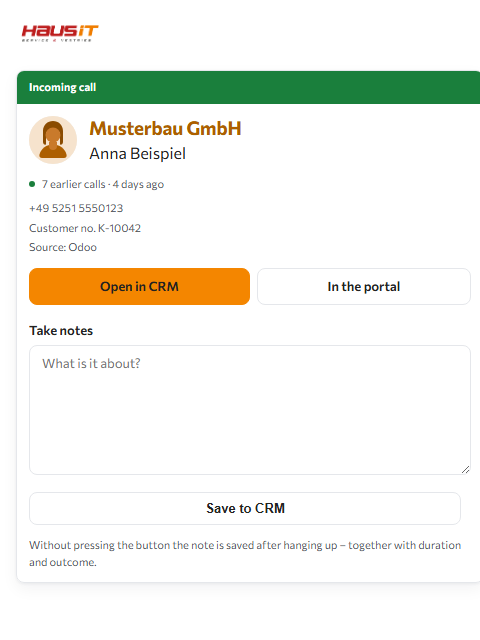
What it looks like
Questions about Oracle Siebel CRM and Webex
How do I see who is calling in Oracle Siebel CRM?
You do not see it in Oracle Siebel CRM but in Webex: Haus iT Caller ID looks the number up in your Oracle Siebel CRM while the phone rings and shows the result in the sidebar of the Webex client – before you pick up.
What appears in the tile then?
Always the caller's name. This system offers no link into the record.
What does the Oracle Siebel CRM connector need?
These details: Address of your Siebel server, User name, Password. The portal shows you where to find them in Oracle Siebel CRM during setup.
Is my customer data copied?
No. The question goes straight to your Oracle Siebel CRM, at the moment of the call. No copy of your customer base is created here, and no call content is processed.
What happens if the caller is not in Oracle Siebel CRM?
Then they stay unknown for now – a contact system knows customers, not suppliers or public authorities. That is what the portal's own number book is for: once someone is named, they are identified from then on.
What does it cost?
The portal with connection to Webex, retention of call data and number book is free, with no limit on workplaces. The Webex tile is billed per user per month.